
You can’t win the raffle if you don’t buy a ticket. That has always been my motto when it comes to getting promoted. Effectively, you need to ask.
But promotions are a tricky thing. Most of the time, you’ve never done the job you are trying to get, and there are typically a lot of people all vying for the same role. As you move up in an organization the ratio of candidates to open roles gets bigger and the competition intensifies. So, what is the best way to get promoted? When should you try to get promoted? Or, does leaving your company for the next job make sense? This post will seek to answer all these questions and more.
Understanding the organizational structure of the company is critical for carving a path to promotion – regardless of the role or level. This is particularly critical when talking about fast growing tech companies because it is common for these companies to change their structure frequently. Sometimes these re-orgs can be due to a failed attempt to scale but that is for another post.
Let’s use a common example of a $50 million ARR (annual recurring revenue) SaaS company.1 You are probably looking at Sales Development Representatives (SDR), Account Executives (AE), Managers/Directors, Vice President, & a Chief Revenue Officer.
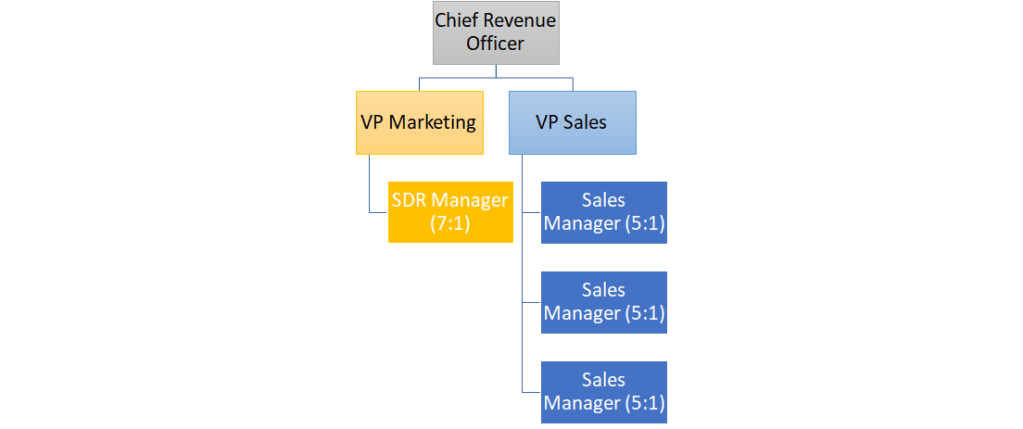
In this example, SDRs have the most opportunity to be promoted because there are 15 Account Executives roles to go after. Assuming average attrition of 20% you can expect there to be about 2-3 open roles per year. For AEs to become managers, there are only 3 roles to pursue. Keeping the same 20% attrition, it will likely mean 2 or 3 years before a role is open if all things stay the same. The same inference can be made as you move up the org chart – the key message is this, the higher you move up the fewer roles there are available and they are available less often.
To land the next job, regardless of the role, there are a few things you need to do that are applicable to everyone. The first, and ultimately most important, is results. It is true that the best individual contributor does not always make the best manager. But, results get you in the door and will be a key measurement of your candidacy.
Second, is start demonstrating you can do the next job without a dip in performance of your current job. If you are an SDR, work with your AE to show you can take deals further in the sales cycle. If you are an AE, mentor other AEs or SDRs and show you can help coach and develop others. If you are a manager trying to become a VP, show you understand the business, models for scale, and can execute high leverage projects.2
Finally, do not underestimate the value of institutional knowledge. External candidates will spend time ramping in domain, product, operations and a host of other things. It typically takes 6 -12 months to get to an even playing field with an internal candidate. This mean that if you can identify your skill gaps and provide a compelling case on how you will bridge those gaps faster than the external candidate will learn your business, you will get the job. It’s cheaper to promote from within because the backfill will before a lower paying job with lower risk to the business.
Value of patience
1A lot of SaaS companies will grow to around $50 million and be faced with a need to change structurally to grow to $100 million. Major revenue milestones often require different structures to scale effectively.
2Andy Grove, the legendary CEO of Intel wrote a great book called “High Output Management.” In this book he discusses in detail what high leverage activities look like.
 The Ferment